

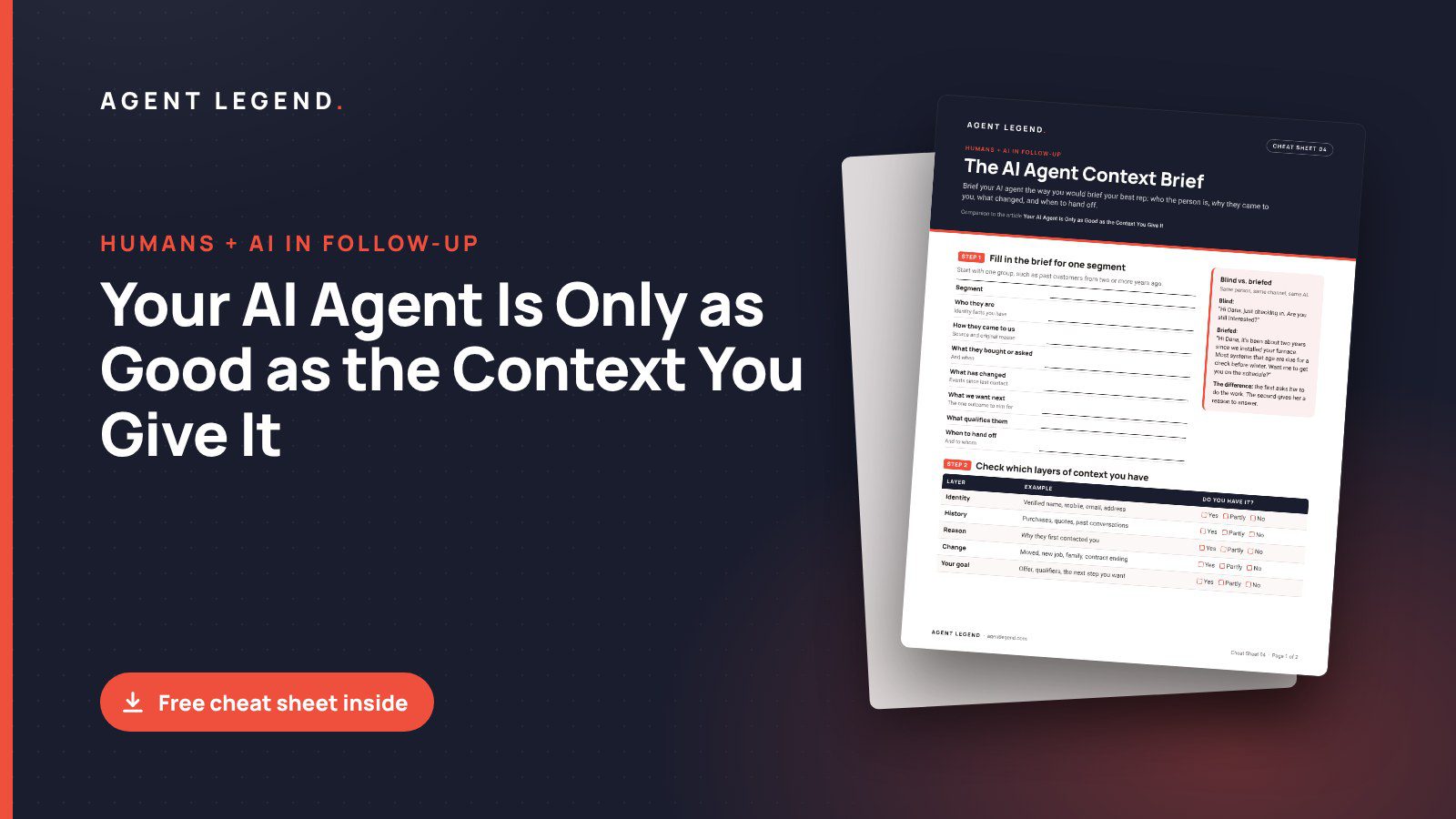
AI can now hold a real sales conversation. Whether it sounds like your best rep or like a spam bot depends almost entirely on what it knows before the first message goes out.
The short answer
An AI agent without context can only send generic messages, and generic messages get ignored. Give it context, meaning who the person is, how they came to you, what they bought, what has changed and what your business wants to happen next, and it can open a relevant conversation, ask better questions and hand off at the right moment. The model matters less than the information you feed it.
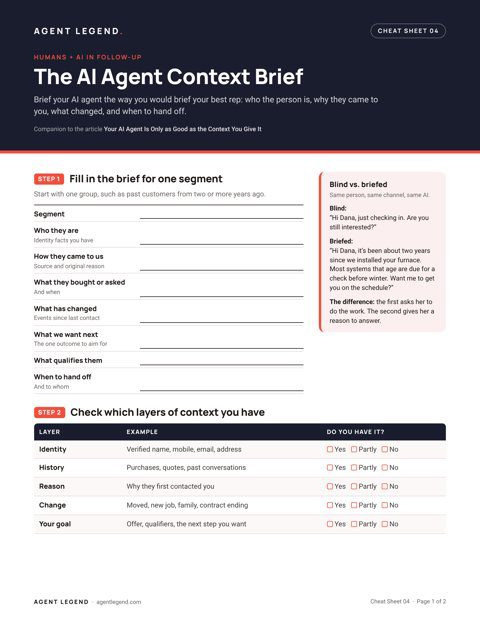
Free cheat sheet
The AI Agent Context Brief
A fill-in brief for any segment, plus guardrails and a handoff template your team can use today.
Download the cheat sheet (PDF)The blind-start problem
Most AI follow-up tools start every conversation at zero. They have a first name, maybe a lead source, and a script. So the opener sounds like this:
“Hi Dana, just checking in. Are you still interested?”
Now compare it with an opener from an agent that knows the customer:
“Hi Dana, it’s been about two years since we installed your furnace. Most systems that age are due for a check before winter. Want me to get you on the schedule?”
Same person, same channel, same AI. The only difference is context. The first message asks the customer to do the work. The second gives her a reason to answer.
What context actually means
Context is not a longer prompt. It is the information about each person and your business that a great salesperson would review before picking up the phone. It comes in five layers:
- Identity: who this person is, verified, with working contact information. (More on that in why identity data comes first.)
- History: every purchase, quote, inquiry and past conversation.
- Reason: why they came to you in the first place.
- Change: what has happened since: a move, a new job, a growing family, a contract coming up for renewal.
- Your goal: what you want to happen next, what qualifies someone, and what a good outcome looks like.
Most systems only capture what a contact did, such as opens and clicks. The layers that matter most are the why: the reason and the change. I wrote more about that gap in why most of your contacts never click.
Context beats clever prompts
Teams spend weeks tuning the wording of their AI prompts. The bigger lever is the data. An average prompt with rich context will outperform a brilliant prompt with none, because the agent can say something specific and true. Without context, even the best-written prompt can only produce polished small talk.
Guardrails are context too
Telling an agent what not to do is as important as telling it what to say. Write these down before you launch:
- Never quote prices, rates or terms it has not been given.
- Never give legal, tax or financial advice.
- Only use channels you have consent for, and respect quiet hours.
- Hand off immediately when someone asks for a person, raises a complaint or is ready to buy.
- Identify itself as an AI assistant where the rules or your values require it.
The handoff is where deals are won or lost
When a conversation is ready for a person, the agent should pass along a short brief: who the contact is, what they said, what they want and the agreed next step. Your rep should never have to ask a customer to repeat themselves. A clean handoff is the moment AI stops being a chatbot and starts being a teammate.
Where to start
- Pick one segment, such as past customers from two or more years ago.
- Write a context brief for that segment using the cheat sheet.
- Compare what you need with what your data actually has, and fill the identity gaps first.
- Launch with a person reviewing the first 50 conversations.
- Tighten the brief and the guardrails, then expand to the next segment.
The bottom line
AI agents are the best consumers of context anyone has built. Feed them the why, not only the what, and they will start conversations your team would be proud of.
That is how we built Hazel, the AI sales agent inside Agent Legend. She reviews what we know about each contact before the first message goes out.
Free cheat sheet
Brief your AI agent like your best rep
The five layers of context, a guardrails checklist and a handoff template, ready to fill in.
Download the cheat sheet (PDF)Frequently asked questions
What context does an AI sales agent need?
At minimum: who the person is, how they came to you, what they bought or asked about, what has changed since, and what your business wants to happen next. Add clear guardrails and handoff rules so the agent knows what not to do and when to bring in a person.
Will an AI agent replace my sales team?
No. A well-briefed AI agent handles first touches, after-hours replies, qualifying questions and the long tail of follow-up. People still build trust, handle complex questions and close. The best teams use AI to make sure their people only spend time on conversations that are ready.
How do I keep an AI agent from saying the wrong thing?
Give it approved information to work from, write down what it must never do, set rules for when to hand off to a person, and have someone review its first conversations before you scale it up.