

Most follow-up tools wait for a contact to do something first. Most contacts never do. Here is how to reach the quiet majority of your list.
The short answer
Contacts who never open, click or reply are not dead. They are unreached. Most follow-up software reacts to behavior, so people who show no behavior get a generic newsletter or nothing at all. To reach them, you have to start the conversation yourself, using what you already know about each person: why they came to you, what they bought, and what has changed since.
Free cheat sheet
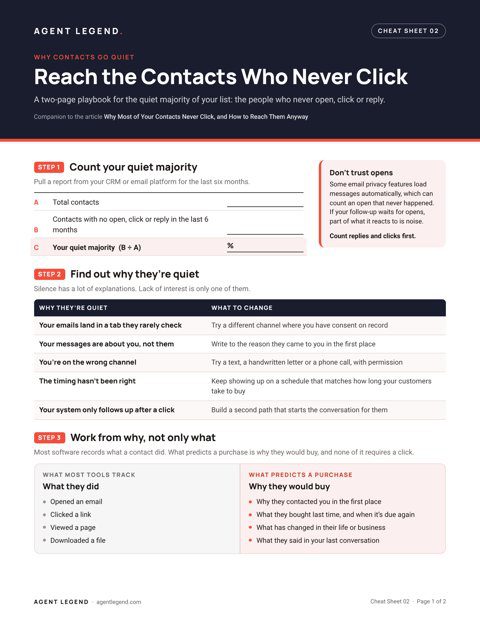
Reach the Contacts Who Never Click
A two-page playbook: find your quiet majority, see why they went silent, and use six moves and four openers to start the conversation.
Download the cheat sheet (PDF)Most follow-up is built to react
Look under the hood of almost any marketing or sales platform and you will find the same design. A contact opens an email, visits a pricing page or clicks a link. The system scores that behavior, moves the contact up a list, and alerts a salesperson or fires the next message.
That works for the people at the top of your list who are already leaning in. It does nothing for everyone else, because the whole system is waiting for a signal that never comes.
The quiet majority
Go into your own CRM and count how many contacts have not opened, clicked or replied to anything in the last six months. For most businesses it is the majority of the list. Many of them have never engaged with a single message.
It is tempting to write those people off. That is a mistake. Silence has a lot of explanations, and lack of interest is only one of them:
- Your emails are landing in a promotions tab they rarely check.
- The messages they have received are about you, not about them, so they scroll past.
- You are reaching them on the wrong channel.
- The timing has not been right yet.
Open data has become less reliable as well. Email privacy features on some devices load messages automatically, which can count an open that never happened. If your follow-up depends on opens, part of what you are reacting to is noise.
What versus why
Here is the gap I see in almost every system we look at. Software is good at recording what a contact did: opened, clicked, viewed, downloaded. That is only part of the story. What actually predicts a purchase is why someone is doing something.
Why did they contact you in the first place? What did they buy last time, and when is it due again? What has changed in their life or business since you last spoke? A homeowner who used a moving company three years ago is a likely customer for that company’s other services. A business on an annual contract is predictable months before renewal. A client who asked about pricing and went quiet usually had a reason, and the reason is often still there.
None of that requires the contact to click anything. It is already in your records, or it can be.
How to reach the people who never engage
Start from the data you already own. Purchase dates, products, locations, the reason for the original inquiry, notes from the last conversation. This is where your best openers come from.
Write to the reason, not the funnel stage. “You are in stage three of our nurture sequence” is how most automated messages read to the person receiving them. “It has been about two years since we helped you with X, and here is something that usually comes up around now” reads like a person who remembers them.
Change the channel. If someone has ignored twenty emails, the twenty-first will not be different. A text, a handwritten letter or a phone call might be, provided you have permission to use that channel.
Ask a question that is easy to answer. A one-word reply is a conversation. A link to a long landing page is homework.
Match your timing to how people buy. Some decisions take weeks and some take years. Keep showing up on a schedule that fits your buying cycle, not your campaign calendar.
Run two paths. Let behavior-based follow-up keep doing its job for people who engage. Build a separate, deliberate path for everyone who doesn’t. Both groups are worth money. Only one of them is getting attention today.
A note on consent
Reaching quiet contacts by text or phone raises the stakes on permission. Before you add a new channel, confirm you have the right consent on record for it. An upcoming post in this series covers what that means in plain English.
The bottom line
The contacts who never click are the part of your list nearly everyone else ignores, and that is exactly why they are worth your attention. Reaching them takes more than another automated sequence. It takes using the context you already have to give each person a real reason to answer.
If you have not put a dollar figure on your quiet majority yet, start with the math on what your database is worth.
That is the work Agent Legend was built to do.
Free cheat sheet
Get the quiet contact playbook
Count your quiet majority, match each reason for silence to a fix, and use four fill-in-the-blank openers that get replies.
Download the cheat sheet (PDF)Frequently asked questions
Should I remove contacts who never open my emails?
Not before you try a different message and a different channel. Removing them stops wasted sends, but it also throws away people you paid to acquire. Clean out hard bounces and opt-outs, then work the rest differently.
What is trigger-based marketing?
Follow-up that only runs when a contact takes an action, such as opening an email, clicking a link or visiting a page. It works well for engaged contacts and does little for everyone else.
How do I re-engage contacts who never responded?
Use what you know about them to write a specific, personal reason for reaching out, try a different channel where you have consent, and ask a simple question they can answer in a few words.