

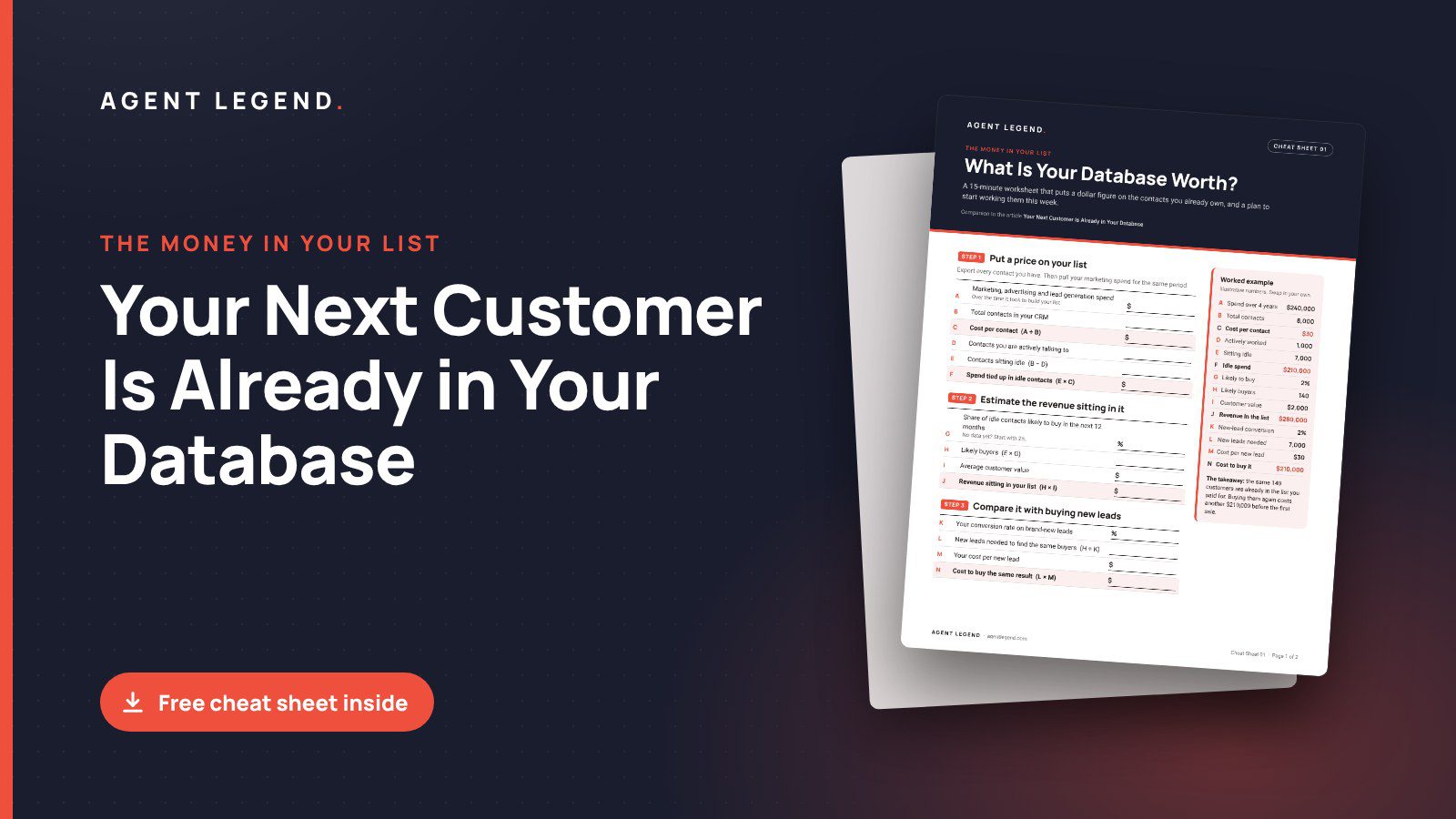
Every business pays to build a contact list, then stops working it. Here is the math on why the people who already know you are your cheapest path to growth.
The short answer
If you want more customers this quarter, start with the people who already know your name. They cost less to reach, they buy faster when the timing is right, and you already paid to get them. Buying more leads before you work the list you have means paying twice for the same customer.
Free cheat sheet
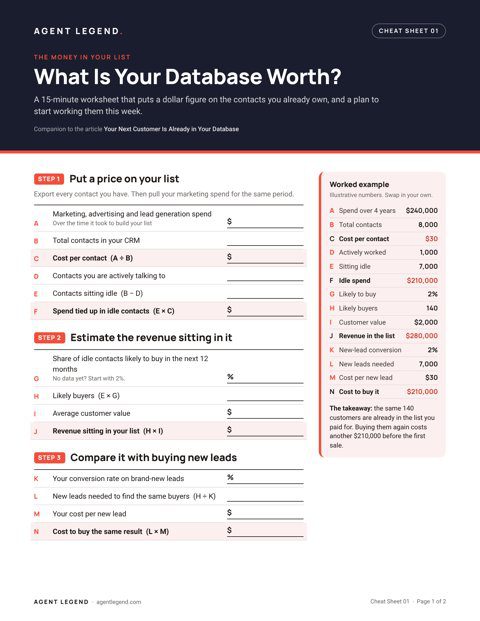
What Is Your Database Worth?
A 15-minute worksheet that puts a dollar figure on your list, plus a first-week plan to start working it.
Download the cheat sheet (PDF)Every business has a list it stopped looking at
Ask a business owner what it costs to land a new customer and you will get a number in seconds. Ask what they spend staying in touch with people who already raised their hand, and most of them go quiet.
Every business builds a list whether it means to or not. Quotes that never closed. Inquiries from two years ago. Customers who bought once and never came back. Webinar signups, trade show badge scans, and the person who called about pricing and said they would think about it. Each of those names cost something to get: ad spend, a salesperson’s afternoon, a booth fee, a purchased lead.
Then most of that list sits in a CRM and ages.
Put a dollar figure on what your list cost
Here is an exercise worth fifteen minutes. Export every contact you have. Count them. Then add up what you spent on marketing, advertising and lead generation over the period it took to build that list. Divide the spend by the number of contacts. That is your cost per contact.
A quick example with round numbers: a business that spent $240,000 on marketing over four years and ended up with 8,000 contacts paid $30 per name. If it is actively talking to 1,000 of them, the other 7,000 represent $210,000 of spend doing nothing.
Your numbers will be different. The pattern almost never is.
The math on old contacts versus new ones
Stay with the same example. Say only 2% of those 7,000 quiet contacts are ready to buy in the next twelve months. That is 140 people. At an average customer value of $2,000, that is $280,000 in revenue sitting in a list you already own.
Now try to get those same 140 customers from scratch. If new leads also convert at 2%, you need 7,000 of them. At $30 each, that is another $210,000 out the door before the first sale.
Working an existing list is not free. It takes time, tools and consistency. But you start a long way ahead of the business buying its way to the same result.
The figures in this example are illustrative. The cheat sheet walks you through the same math with your own numbers.
Why good lists go untouched
I have spent fifteen years watching businesses build databases and then leave them alone. It is rarely laziness. It usually comes down to a few things.
Follow-up depends on someone remembering. When the busy season hits, the first thing to go is the call to the person who said “not yet” six months ago. Real estate has studied this more closely than most industries. An Inman article from January 2025 noted that some experts put it at 8 to 12 touches to convert a lead, while most agents quit after two or three. Swap in your industry and I would bet the gap looks similar.
Most software waits for the contact to act first. If someone opens an email or clicks a link, the system wakes up. If they don’t, nothing happens. The quiet majority of your list gets a newsletter at best. I break down why, and how to reach them, in Why Most of Your Contacts Never Click.
Nobody knows who to contact first. A list of 8,000 names with no signal feels impossible, so nobody starts.
“Not now” is not “no”
People buy on their timeline, not yours. The prospect who passed on your quote in March may have a new budget in November. The customer who bought once may be due again and has simply forgotten who did the work last time. If you are not there when the timing changes, someone else will be, and they will look like the obvious choice because they showed up.
What working your list looks like
- Split the list by what you already know: past customers, quoted but not closed, inquiries that went quiet, and contacts who never engaged at all.
- Give each group a reason to hear from you that is about them, not about your latest promotion.
- Stay consistent for longer than feels comfortable. Most buying decisions take months.
- Reach the people who never respond, not only the ones who click. They are most of your list.
- Make it easy to raise a hand, and have someone ready to talk the moment they do.
Where to start this week
Pull the list. Count it. Put the dollar figure on it and share it with your team, because that number changes the conversation fast. Then pick one segment, such as everyone who received a quote in the last 18 months and never bought. Send them one useful message with a clear reason for reaching out, and watch who replies.
One rule before you hit send: if you plan to text or call, make sure you have the consent to do it. We will cover that in plain English in an upcoming post.
The bottom line
Your data is your asset. You paid for every name in that list, and most of those people still remember you. The businesses that grow next year will not be the ones buying the most leads. They will be the ones that finally go back to the people who already said hello.
That is the problem we built Agent Legend to solve.
Free cheat sheet
Run the numbers on your own list
Two pages, print-ready: the database value worksheet, a four-group split of your list, a first-week checklist and a 30-day tracker.
Download the cheat sheet (PDF)Frequently asked questions
Is it worth contacting leads that are more than a year old?
Yes. Interest fades, but needs come back on their own schedule. An old contact who already knows your business is usually easier to restart a conversation with than a stranger.
How often should I contact an old lead or past customer?
Often enough to stay familiar, never so often that it feels like pressure. A useful touch every few weeks beats a sales pitch every few days.
What should I send to a cold contact first?
Something useful with a clear reason attached: a change in your market, a seasonal reminder, or a direct question about where they landed.