

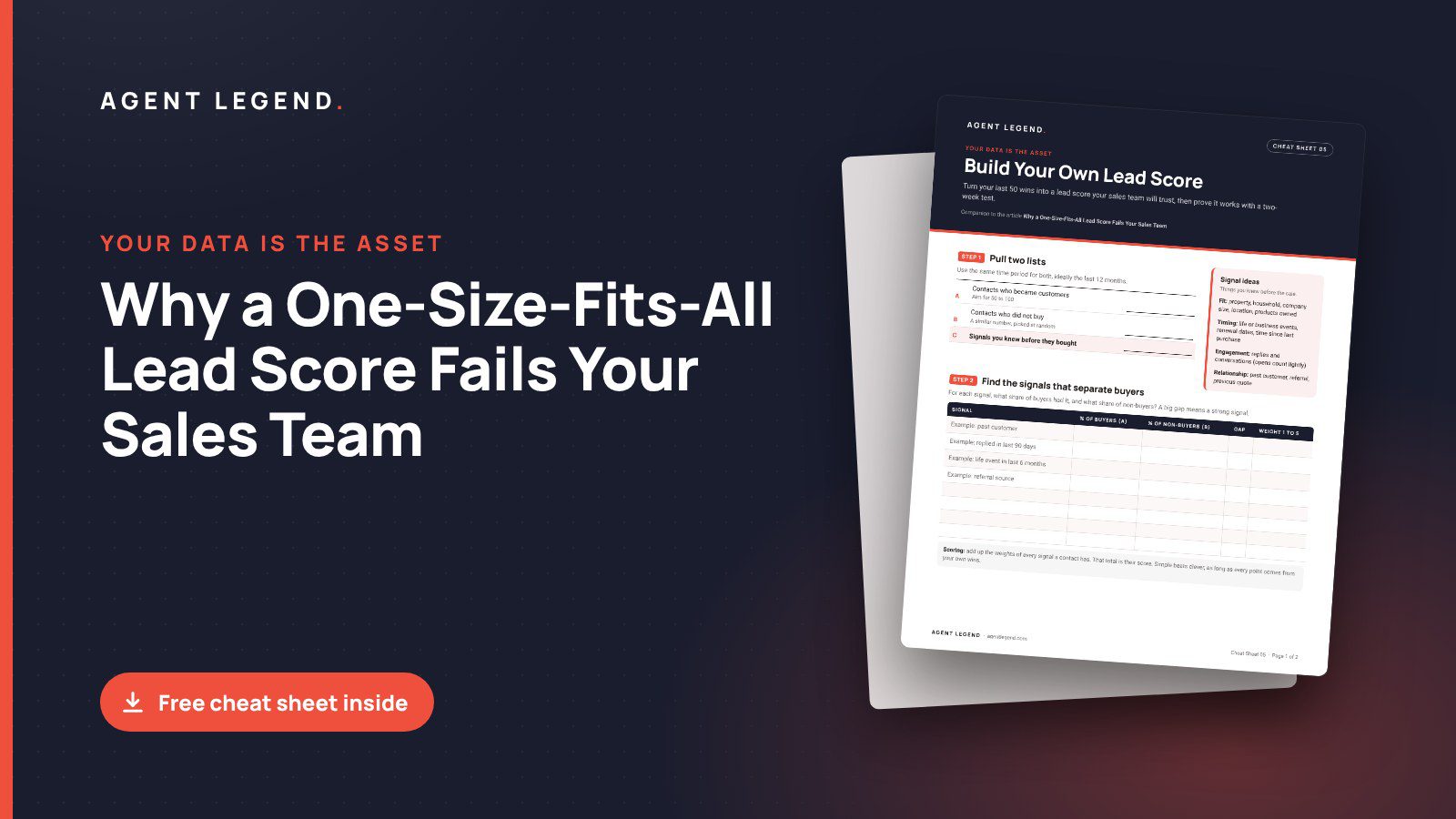
Generic lead scores reward clicks and punish the quiet buyers who make up most of your list. The score that works is the one built from your own wins.
The short answer
A lead score only works if it predicts who will buy from you. Off-the-shelf scores add points for opens, clicks and page views, or rely on patterns averaged across many other companies. Your customers, prices and buying cycle are different. A custom score is built from your own closed deals: the traits and signals your best customers shared before they bought. It ranks your whole database, including the people who never click.
Free cheat sheet
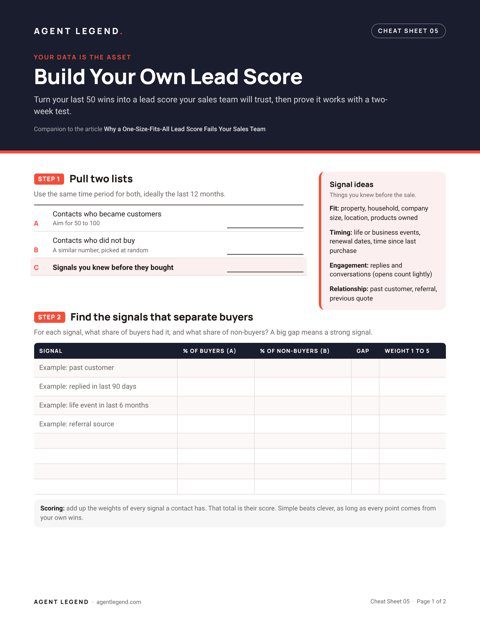
Build Your Own Lead Score
A worksheet that turns your last 50 wins into a weighted score, score bands and a two-week test.
Download the cheat sheet (PDF)How most lead scores work
Most scoring systems use points. Open an email, plus five. Visit the pricing page, plus ten. Request a demo, plus twenty. No activity for 30 days, minus ten. Others use a vendor model trained on data from many companies at once. Both approaches are easy to switch on, and both share the same flaw: neither one was built around your business.
Three reasons generic scores miss
They reward activity, not likelihood. Points for opens and clicks favor the people who engage with email, and email privacy features inflate opens on top of that. Meanwhile the quiet majority of your list scores zero, even when they are exactly the people about to buy. I covered that blind spot in why most of your contacts never click.
They average away what makes you different. A roofing company’s best customer looks nothing like a mortgage lender’s or a software company’s. A model built on everyone’s data describes no one in particular.
Nobody trusts them. When a rep calls three contacts scored 90 and none of them answer, the team stops looking at the score. A score nobody uses is worse than no score, because it gives everyone false confidence.
What a custom score is built from
A custom score starts with your outcomes: closed deals, booked appointments, renewals. Then it looks at what those people had in common before they bought. The signals usually fall into four groups:
- Fit: who they are. Property, household, company size, location, products they already own.
- Timing: why now. Life or business events, contract and renewal dates, time since their last purchase.
- Engagement: what they did. Replies and real conversations count far more than opens.
- Relationship: how they know you. Past customer, referral source, a previous quote.
Fit and timing signals depend on good identity data. If you do not know who someone is, you cannot score them fairly.
How to build a simple version yourself
- Pull your last 50 to 100 closed customers and a similar number of contacts who did not buy over the same period.
- List the traits and signals you knew about each person before they bought.
- Find what separates the two groups. Those differences are your signals.
- Weight each signal by how strongly it separated buyers from everyone else.
- Score your whole database and group it into bands, A through D.
- Test it: work the A band and a random sample side by side for two weeks, and compare conversations and appointments.
- Re-check every quarter. Signals that stop predicting get retired.
Make the score explainable
A number alone does not help a rep. A number with a reason does. “Score 88: past customer, homeowner seven years, asked about pricing in March” tells your team who to call and what to say. Explainable scores get used. Black-box scores get ignored.
Score the whole list
The point of a custom score is not to rank the people already raising their hands. It is to find the quiet contacts with strong fit and the right timing, and move them to the top even if they have never clicked a thing. That is how you find your next customer in the database you already own.
The bottom line
A lead score should answer one question for your sales team: who should we talk to today, and why? A score built from someone else’s data cannot answer that. Yours can.
That is how we think about scoring at Agent Legend: built around each customer’s own data and results, not a one-size-fits-all model.
Free cheat sheet
Turn your wins into a lead score
Signal worksheet, weighting table, score bands and a simple test plan, all on two pages.
Download the cheat sheet (PDF)Frequently asked questions
What is predictive lead scoring?
Predictive lead scoring uses data about past outcomes, such as which contacts became customers, to estimate how likely each current contact is to buy. Unlike point-based scoring, it learns which signals actually matter instead of relying on someone’s guess.
How much data do I need to build a custom lead score?
You can start with a few dozen closed deals and a comparison group of contacts who did not buy. More history sharpens the score, but a simple, explainable score built from your own wins is usually more useful to a sales team than a generic one.
Should email opens count in a lead score?
Lightly, if at all. Email privacy features can register opens that never happened, and opens say little about intent. Replies, conversations and real-world timing signals are far better predictors.